


Meagan Cea, Business Analyst with the Research Informatics group, worked in three different reserach departments at WCM before joining ITS. After learning the ins and outs of what researchers must do to initiate a study, she's now happy to be on the other side of the table, saying "yes" to researchers proposals and combing through their technical details to help ensure success.
What is your current role in ITS?
My title is Research Informatics Business Analyst. Essentially, I help pull medical records for research purposes.
And is this your first role at Weill Cornell?
Oh, no, I've been around for 11 years in January. I've had a number of different roles. I started in what used to be the Healthcare Policy and Research Division, that was my first role out of grad school. They were subsumed by the Department of Population Health Sciences. I started there as a Research Coordinator. I was there for about a year and then I ended up transferring to the radiology department, where I was a Research Coordinator and I stayed there for about five years. Then I was in the JCTO as a Research Specialist. My role was managing and rolling out the electronic consent process, which was new at the time during the pandemic. I was there for two years, and then I came here. I've been in this role for about three years.

Meagan on a fishing trip with her in-laws
You mentioned that you joined Healthcare Policy and Research right after graduate school. What did you study in grad school?
I have my Master's in Data Analytics and Applied Social Research. That's a type of sociology degree at Queens College. Originally, I thought I was going to go into marketing research. That's what most people were using that for.
But you went the healthcare route...
It was honestly a weird confluence of events because I ended up doing my Master's thesis on healthcare. I was looking at preventative medicine trends and when I was in my last semester, we were contacted by Michael Pesco, who was one of the investigators in the Healthcare Policy Department.
They were looking for an analyst and they were scouting the program for a good fit. I always tell everybody, this is an example of “you don't make any of the shots you don't take” because I applied for the position knowing that I was not qualified for it, but I did well enough in the interview that they decided, okay, you don't have the experience to be an analyst, but we were thinking of hiring a coordinator anyway. So why don't we have you in that position.
You’ve worked in three different departments at Weill Cornell before joining ITS?
Yeah.
How do you feel like your experience in those roles contributes to how you fulfill and succeed in your current role?
Being a research coordinator was the best experience I could have possibly had for what I'm doing now. That and when I was in the Joint Clinical Trials Office. As a research coordinator, I learned what researchers have to go through in order to get the study started. And part of what my team does now is to review PRMC applications to make sure that there are no technical concerns regarding the data.
I used to write protocols and informed consent forms when I was a research coordinator. I'm good at reading those and understanding what information is supposed to be in there.
Also, because I used to handle the IRB process it was easy when I came in to take over some of the department's internal protocols and make sure that everything is running smoothly and amendments are handled quickly.

Meagan's Halloween tree
What is your favorite part of your current job?
I love that I get to say “yes” a lot because I haven't always been able to do that.
A huge part of my role right now is to lead TriNetX. I get to have a lot of positive interactions with people where I'm just providing training and explaining these awesome tools that they didn't know were available.
Are there any projects and initiatives you're working on right now you'd like to highlight?
I'm always promoting TriNetX, it is so incredibly useful and it's one of our most intuitive tools. You can use it to get counts for cohort populations. If you need numbers when you're writing a protocol and you can't access PHI yet, it's useful for that. There are all sorts of de-identified data that you can request without needing a full board protocol. And because it's a self-service tool, it can be a lot faster and simpler than requesting reports. It essentially gives a data dump of all of the selected patients' entire medical histories from the contributing institutions. You can get years and years of data for eligible patients, and then you can then proceed to do your own analysis and figure out what information you want for your research.
It removes a lot of barriers for secondary data analysis research that normally exist. It has amazing potential for students, and it's great for people who don't have a ton of research experience and are trying to get their foot in the door.
How do people know about this? Do you reach out to the research community or do people come to you?
I've done a number of presentations. Sometimes when we have people reach out to ARCH for a report, I will explain to them. We try to make sure that the entire college knows that this is available.
Do you have any hobbies outside of work?
I'm a big reader.
What are you reading right now?
Right now I'm reading Elf Land by Freda Washington, it’s a high fantasy novel. And I'm also reading Glass Universe, which is about women who worked for the Harvard Observatory during the 19th century and did most of the calculations in the astronomy department.

Phlox in bloom. Meagan's green thumb at work!
How interesting. Is this tied to the Geek Session presentation you’re giving in March?
I am going to discuss them, yes! (Plug for Geek Sessions!) I read a lot of women's history, a lot of biographies.
Are there any biographies that you recommend?
One of the ones I'm going to be talking about in my presentation is of Rosalind Franklin. She's sometimes referred to as the Dark Lady of DNA. It was her research that provided the information for Watson and Crick to determine the double helix structure. They got all of the credit by leapfrogging over her.
Are there any other women you admire and why?
You got to be more specific. Are we talking living, dead, historical, somebody that I know?
Let's do: one living, one dead, and one that you know.
Dead: Eleanor Roosevelt. Can't go wrong with that. She was so intelligent, so dynamic, and she just lived this very, very full life. She had an incredible evolution in her personal philosophies and experiences.
Living: Elizabeth Warren. She's a fascinating person. She came from a relatively conservative background. She was a registered Republican. She had initially gone to school on a scholarship. She dropped out before she graduated to get married and have kids. And the only reason that she was able to rejoin the workforce was because she happened to have an aunt who was willing to move in and subsume all of the childcare responsibilities. She's been very open about how difficult these things are and how it affects all women and their ability to participate in the workforce. She essentially had a political conversion when she started studying bankruptcy law. She was assigned the class after she graduated, it wasn't something that she chose, but when she actually started doing the research she started learning that all of her preconceived notions about who it was claiming bankruptcy were wrong. She thought it was people taking advantage of the system. And then she actually did the research and discovered, no, these are people who have had terrible luck. They've had healthcare issues, lost jobs. People, who, in most cases, tried to do everything right, but something completely out of their control happened. And this was the only choice that they had. She's extremely data-focused and she still manages to talk about things that are very technical and complicated in an accessible way. She's so energetic, too. She's in her 70s!
And for somebody that I know who I admire: my mother. I would not be the person I am today without her. She demanded that I do well in school. I was not allowed to stop at a Bachelor's degree. I had to get a Master's. There was no discussion on that whatsoever.
You know, of all the things you can demand of your daughter, I think a master's degree is an awesome one.
Exactly. I was taught from a very, very young age that I was going to take my education very seriously.
Take your education seriously, but your holidays lightly.
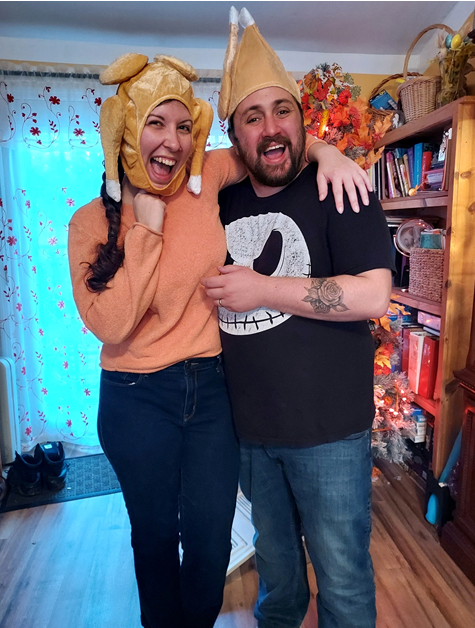
Meagan and her husband celebrating Thanksgiving.